

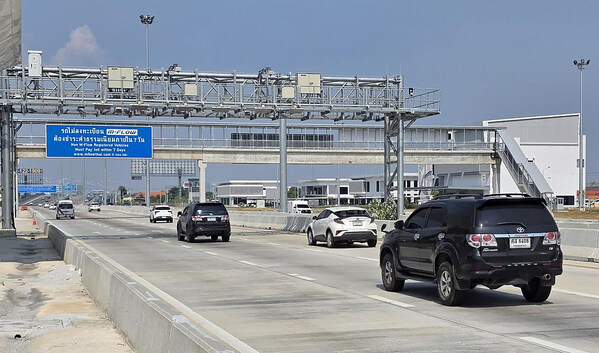
TAIPEI, April 22, 2026 /PRNewswire/ — Sightings of electronic toll collection (ETC) gantries resembling those used on Taiwan’s freeways have recently drawn attention on social media along the Bangkok–Kanchanaburi highway. Far Eastern Electronic Toll Collection Co., Ltd. (FETC) confirmed that the system is part of Thailand’s newly launched M-Flow multi-lane free-flow tolling system on the Intercity Motorway No. 81 Bang Yai – Kanchanaburi Route (M81).

Far Eastern Electronic Toll Collection has successfully supported Thailand in deploying and operating the electronic toll collection system for the M81 motorway, which has now officially commenced operations.
Developed in collaboration with FETC International (Thailand) Co., Ltd. (FETCi Thailand) and the BGSR81 Co., Ltd, the system has officially entered operation, marking a significant milestone in Thailand’s transition toward smart, digitally enabled highway infrastructure.
The launch also strengthens connectivity between Bangkok and Kanchanaburi, effectively creating a “one-day travel corridor” and supporting regional tourism and economic activity.
AI-Driven Tolling Cuts Travel Time to 48 Minutes
According to Kenny Chen, Managing Director of FETCi Thailand, the M81 project demonstrates the flexibility and scalability of Taiwan’s ETC technology in complex international environments.
FETCi Thailand led the design, installation, and implementation of the tolling system and its Traffic Operations Center (TOC). The platform integrates artificial intelligence (AI) and Internet of Things (IoT) technologies to enable data-driven traffic management and operational decision-making. It is also designed for future expansion, including applications such as weigh-in-motion enforcement.
Thailand’s diverse vehicle types and more complex license plate formats presented technical challenges. These were addressed through advanced AI-powered automatic license plate recognition (ALPR), ensuring high accuracy in vehicle identification. Combined with multiple digital payment options, the system allows vehicles to pass through toll points without stopping.
Since its launch, travel time between Bangkok and Kanchanaburi has been reduced from nearly two hours to approximately 48 minutes. Weekend traffic volumes have reached around 55,000 vehicles per day, improving both tourism access and logistics efficiency in western Thailand.
M9 Experience Highlights Strong Economic and Environmental Benefits
FETC has also supported Thailand’s Department of Highways (DOH) since 2022 in deploying and operating the M-Flow system on the M9 motorway, including gantry design and operational consulting.
According to DOH data, the system has increased traffic throughput fivefold and saves motorists an estimated 3.33 million hours annually. It has achieved a benefit-cost ratio of 6.94, meaning each dollar invested generates nearly seven dollars in overall societal value.
In environmental terms, the system reduces fuel consumption by approximately 13.91 million liters per year and cuts carbon emissions by more than 36,000 metric tons, contributing to more sustainable transportation.