

A Market‑First Measure of Longevity Readiness in Health and Wealth
The overall Index score stands at 62 out of 100, placing HNW and UHNW families in the “Developing” range, with healthspan readiness lagging behind wealth planning
HONG KONG, May 12, 2026 /PRNewswire/ — AIA Alta, AIA Hong Kong’s unique proposition exclusively for its high-net-worth (HNW) and ultra-high-net-worth (UHNW) customers, today announced the launch of the AIA Alta High‑Net‑Worth Optimal Longevity Index[1] (“the Index”). Initiated by AIA Alta and developed by Boston Consulting Group (BCG), the Index is a first‑in‑market framework drawing on research analysis provided by BCG to measure the longevity readiness of HNW and UHNW individuals across health and wealth in Hong Kong and the Chinese Mainland.
The inaugural Index recorded an overall score of 62 out of 100, placing the segment in the “Developing” band. This indicates that (U)HNW families recognise long‑age challenges, but these have not yet been fully translated into repeatable, institutionalised mechanisms, particularly when managing health, wealth, and legacy decisions across multiple jurisdictions.
Key findings reveal that while approximately 80% of HNW individuals have established at least one wealth continuity mechanism (such as wills, trusts, or succession plans), only around 20% have health-decision continuity mechanisms (such as medical directives or decision‑authorisation documents) in place — highlighting that affluent families focus heavily on financial planning while neglecting critical health and medical decision arrangements. Additionally, up to 79% of UHNW respondents identify integrated coordination across health, investment, insurance, and finances as their most critical need.
Alice Liang, Chief Proposition & Healthcare Officer of AIA Hong Kong & Macau, said: “To truly elevate longevity into ‘longevity readiness’, ‘health’ planning and ‘wealth’ planning must carry equal weight. We introduced the AIA Alta High‑Net‑Worth Optimal Longevity Index to provide a clear, fact‑based understanding of how ready these families are for longevity, and where the most significant execution gaps lie. Insights from the Index enable AIA Alta to translate research findings into practical, actionable solutions, supporting customers in building longer‑term, sustainable plans that remain effective across generations and jurisdictions, and ultimately achieving an optimal balance of wealth and health.”
Ms Liang added: “The Index makes one point very clear: longevity cannot be managed in silos. While families understand what matters and are confident in their ability to respond, the routines, documents, decision authorisation, governance structures and cross‑border pathways required to execute decisions are not yet fully institutionalised. Through AIA Alta, we are redefining longevity by orchestrating health and wealth into one integrated system, empowering families to protect today, grow tomorrow and sustain legacies across generations.”
How the Index Works
The AIA Alta High‑Net‑Worth Optimal Longevity Index provides a structured measurement system scoring longevity readiness on a scale of 0 to 100 that can be repeated year after year. It measures readiness across two equally weighted pillars, Health and Wealth, using three easy-to-grasp measures:
- Awareness (30%): how respondents understand key health- and wealth-related risks, implications, and emerging trends associated with longer lifespans
- Confidence (30%): how confident respondents feel about their ability to maintain long-term health and wealth wellbeing, independence and quality of life
- Preparedness (40%): how far respondents have put plans into action, including having the right documents, structures, resources and routines in place to respond when circumstances change
The Index groups scores into five “readiness bands” to make results easy to interpret: 0–49 (Vulnerable), 50–59 (Foundational), 60–69 (Developing), 70–79 (Optimising), and 80–100 (Mature). Vulnerable indicates major gaps, with limited plans that may not hold up when circumstances change. Foundational reflects initial steps taken, but with limited depth or coordination. Developing indicates good awareness and confidence, but inconsistent execution. Optimising reflects more structured, actively reviewed plans, while Mature represents plans that are highly organised and repeatable, working consistently across time, events, and jurisdictions.
Overall Index Insights
The inaugural overall score of 62 out of 100 places HNW and UHNW families in the Developing range with strong awareness (74) but weaker preparedness (54), revealing a clear execution gap. It highlights several defining behavioural and structural shifts among (U)HNW families today:
- Cross‑border complexity is sharply elevating the need for an integrated orchestrator.
Up to 79% of UHNW respondents say integrated coordination of health, investment, insurance and finances would add significant value to their advisory relationships, well above HNW (63%). This underscores that fragmentation across jurisdictions is now a critical barrier demanding unified execution support.
- Execution readiness is uneven: wealth continuity is strong, health continuity is significantly underdeveloped.
Approximately 80% of (U)HNW have established at least one wealth-decision continuity mechanism — including wills, trusts, governance frameworks or succession planning. Yet only around 20% have a health-decision continuity mechanism in place, such as medical directives or decision‑authorisation documents, revealing a major structural gap in health governance even among the wealthiest families.
- Demand for institutionalised, family‑office‑style governance is accelerating among UHNW families.
UHNW respondents overwhelmingly prioritise expert-network services such as cross‑border tax planning and coordination (75%), wills planning and execution (71%), integrated health and longevity planning (64%), and trust structuring, governance and management (61%) — demonstrating a shift from ad‑hoc advice to formalised, multi‑disciplinary governance. Specifically, 47% of HNWs and 61% of UHNWs who report confidence in portfolio resilience have not conducted stress testing or established regular review mechanisms, revealing a significant confidence-execution gap.
- Longevity planning expands to next-generation capability building and development.
While only around 30% of respondents have already completed next-generation training and capability preparations, a larger proportion plan to put next-generation development structures in place within the next 12 months. This pattern is more evident among second‑generation and Chinese Mainland HNW and UHNW individuals. The findings suggest that longevity planning among HNW families is expanding beyond capital management, extending further into capability building, sustaining social connections, and advancing next-generation development.
AIA Alta – A Leader for Multi‑Generational Wealth and Health Planning
Insights from the Index highlight the need to strengthen both wealth and health longevity readiness as lifespans extend and cross‑border complexity rises. AIA Alta continues to elevate its proposition, responding to customers’ increasingly complex cross‑market wealth, health and legacy planning needs. This includes the official opening of the AIA Alta Prestige Wealth Centre at AIA Central, the industry-first Family Health MedTeam service[2], as well as the three‑year exclusive partnership with the Golf Association of Hong Kong, China to nurture the next generation of golfing talent.
Through a fully integrated approach, AIA Alta delivers curated wealth management services, wellness experiences, lifestyle privileges and next‑generation development programmes, to empower HNW and UHNW families to pursue Healthier, Longer, Better Lives across generations.
Access to the full report

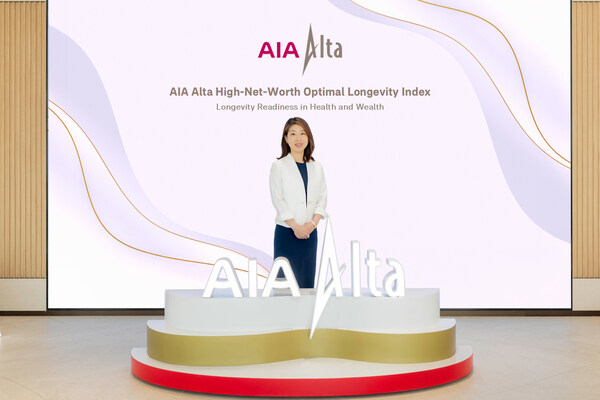
AIA Alta High-Net-Worth Optimal Longevity Index, a market-first measure of longevity readiness in health and wealth, is unveiled. Pictured: Alice Liang, Chief Proposition & Healthcare Officer of AIA Hong Kong & Macau.
About AIA Hong Kong & Macau
AIA Group Limited established its operations in Hong Kong in 1931. To date, AIA Hong Kong and AIA Macau have more than 19,000 financial planners*, as well as an extensive network of independent financial advisors, brokerage and bancassurance partners. We serve over 3.7 million customers^, offering them a wide selection of professional services and products ranging from individual life, group life, accident, medical and health, pension, personal lines insurance to investment-linked assurance schemes with numerous investment options. We are also dedicated to providing superb product solutions to meet the financial needs of high-net-worth customers.
|
* As at 31 December 2025 |
|
Remarks: |
|
|
1 |
The survey covers 328 qualified respondents across Hong Kong and Chinese Mainland who participated in the survey and in‑depth interviews. Detailed analysis focuses on 201 high-net-worth and ultra-high-net-worth respondents with investible assets above |
|
2 |
As of 16 September 2025, Hong Kong insurance industry’s first healthcare support in the Chinese Mainland, which integrates Online General Health Consulting along with Personalising Health Checkup at Grade 3A Hospitals and Online Support for Chronic Disease Management and Home Medication Delivery, Priority Booking for Outpatient and Inpatient Services, and Medical Companion Service, was compared with the similar services offered by major Hong Kong insurance companies. |
|
Important Information: |
|
|