

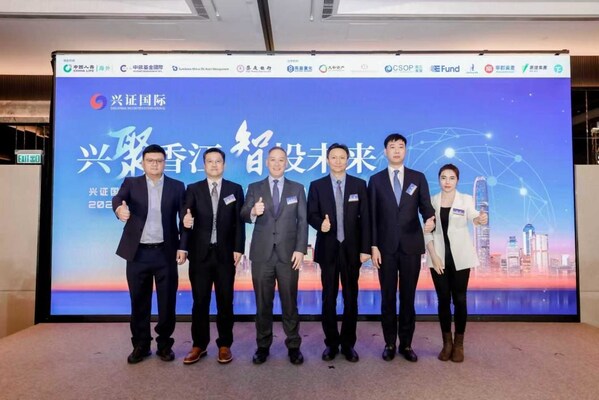
HONG KONG, April 23, 2026 /PRNewswire/ — Against the backdrop of continued repricing in global capital markets and accelerating technological change, China Industrial Securities International Financial Group Limited (“CISI”, stock code: 6058.HK) successfully held in Hong Kong on April 20 the “Gathering in Hong Kong, Investing Intelligently for the Future — CISI 2026 Overseas Wealth Management Summit”. Focusing on key topics including the outlook for global capital markets, overseas multi-asset allocation, cross-border fixed-income strategies, AI investment, and quantitative methods, the summit brought together leading professionals from securities research, asset management, and wealth management for in-depth exchanges with industry participants on-site. Leveraging Hong Kong’s role as an international financial centre and a vital bridge, the event injected fresh momentum into the development of the cross-border wealth management industry by exploring ways to address and overcome the challenges of overseas investment and cross-border wealth management in a new cycle.

A Global Perspective on New Cross-border Wealth Opportunities
At the opening session, Wang Bin, SMD, Assistant to the Group President of China Industrial Securities Co., Ltd. and Head of the Research Institute, delivered welcoming remarks; Robert Lee Wai-wang, Member of the Legislative Council of the Hong Kong Special Administrative Region, Permanent Honorary President of the Hong Kong Securities Association, and Vice Chairman of The Chinese General Chamber of Commerce, gave remarks as guest of honour; and Lin Dan, Executive Director and Chief Executive Officer of CISI, spoke on behalf of the organiser. The three speakers shared insights on global market shifts, Hong Kong’s role as an international financial centre and bridge, and the new trends and challenges facing the cross-border wealth management industry, setting the stage for the day’s forum.
Wang Bin noted that 2026 presents both opportunities and challenges for global markets. The attractiveness of offshore renminbi assets is rising, while Chinese and international asset allocation is entering an important window of opportunity. As the opening year of the 15th Five-Year Plan, 2026 will see AI-driven industrial upgrading gather pace, with Hong Kong’s strengths as a financial hub becoming increasingly prominent. He said CISI would continue to leverage Hong Kong as its base to provide clients with one-stop cross-border financial solutions.
Robert Lee said Hong Kong is preparing its first five-year plan and will align more closely with national development strategies while reinforcing its role in renminbi business and as a wealth management centre. He added that the Legislative Council has continued to promote market reform by lowering stamp duty and optimising dual-counter trading, thereby comprehensively enhancing market liquidity and competitiveness.
Lin Dan stressed that, amid profound adjustments in the global geopolitical landscape, Hong Kong’s role as a core bridge linking Mainland China and global capital markets has become even more critical. As the country’s new quality productive forces continue to unlock investment opportunities in AI and new energy, CISI — following a strong performance in 2025 — will seize opportunities in the Greater Bay Area and further strengthen its cross-border financial services.
From Macro Judgement to Strategy Execution: Addressing Practical Investment Challenges
Following the opening remarks, the forum moved into the keynote speech session, where speakers shared views on market outlook, asset allocation, cross-border fixed income and quantitative technologies, translating macro judgement into practical investment strategies and addressing with precision the core allocation needs of institutions and high-net-worth investors.
Zhang Qiyao, Assistant to the Dean of Research Institute of Economics and Finance, General Manager of Strategy Research Center, Strategy Chief Analyst, China Industrial Securities Research Institute of Economics and Finance, shared his views on “Global Capital Market Outlook”. He noted that the impact of geopolitical shocks on the market was gradually fading, that oil-price volatility was likely to be short-lived, and that the Federal Reserve was expected to maintain an accommodative monetary environment, supporting the recovery of global assets. He added that inflation in the United States remained broadly manageable, that earnings support for the AI sector was solid, and that the current rally still had room to run. Hong Kong equities, meanwhile, remain at low valuations and may see a recovery in the second half of the year.
Wang Yi, Vice President and Chief Investment Officer of CSOP Asset Management, focused on “The Art of Offence and Defence in Overseas Multi-Asset Allocation in 2026”. He said the correlation structure among global asset classes is being reshaped, the traditional hedging logic between equities and bonds has become less effective, and US Treasuries are now better suited to range trading. Opportunities along the AI industrial chain are concentrated in storage and downstream semiconductor segments, while Japan, South Korea, and Taiwan region are demonstrating notable strengths in advanced manufacturing. He added that Japan’s reflation and wage-growth cycle is underpinning stronger equity performance, while gold is taking on characteristics closer to those of a risk asset and therefore requires prudent positioning. Global capital, he noted, is gradually increasing allocations to Japan, South Korea and emerging markets.
Lyu Dong, Executive Director and Fund Manager at GaoTeng Global Asset Management, shared practical insights in his presentation titled “Cross-border Fixed-income Strategies in Volatile Markets: Low-to-Medium Volatility Approaches in Practice”. He said current markets remain highly volatile, with medium- to long-term US Treasury yields trending downward, while the renminbi is expected to appreciate gradually and remain broadly stable overall. In terms of allocation, he highlighted three areas of optimism: AI infrastructure, inflation-resistant sectors and the overseas expansion of new energy. He also noted that overseas low- to medium-volatility fixed-income products remain in short supply, and said his team takes absolute return as its core objective, strictly controls drawdowns, and builds low-volatility, resilient strategies for Mainland investors through cross-border FX hedging and diversified asset allocation.
Wu Chao, Chairman of Going Quant, then shared industry insights in his presentation, “The Art of the Microsecond-Level Game: From Algorithmic Revolution to Chip-Level Acceleration”. He said AI and chip technologies are deeply reshaping the field of quantitative investment, not only by processing data and optimising risk control in active management, but also by enabling automated factor mining in quantitative strategies and transforming traditional investment models. AI-driven high-frequency market-making strategies, he noted, do not rely on directional market forecasts and offer the advantages of low volatility and limited drawdowns. His team, he added, leverages FPGA and GPU computing power to execute trades at the microsecond level, while generative AI and quantum computing are expected to continue driving industry innovation.
Diverse Perspectives Converge to Explore Practical Paths in Overseas Investment
Following the keynote speeches, the forum moved into its first roundtable discussion. Moderated by Zhang Linyue of the Wealth Management Department of CISI, the session brought together Zhang Xinyuan, Researcher in the Index Department at E Fund International; Deng Zhida, Senior Portfolio Manager at Sumitomo Mitsui Hong Kong; Feng Jingkun, Director of International Multi-Strategy and Private Wealth at Zhong Ou Fund; and Guo Xiaolin, Senior Fund Manager, Equities Investment, at Value Partners Group. The four experts from leading public fund institutions engaged in an in-depth discussion on some of the market’s most topical investment issues. The roundtable centred on four core themes: opportunities from AI-enabled industrial transformation, investment logic in Asia-Pacific markets, the application-driven transformation enabled by AI agents, and breakthroughs in computing power, energy consumption, and technology. The panellists agreed that AI has moved from infrastructure buildout to scaled real-world application, driving coordinated development across the entire value chain; that Asia-Pacific markets offer compelling allocation advantages and are entering a period of long-term opportunity; and that competition in computing power and optimisation of energy use will become critical to future industrial development, with technological innovation and efficiency gains continuing to support high-quality growth.
The second roundtable focused on overseas private funds and was moderated by Li Chen, Head of the Wealth Management Department at CISI. Participating in the discussion were Wang Ximei, Executive Director of Going Quant; Yan Keyi, Founder and Chief Investment Officer of Dapu Asset; Yang Ping, Founder and Chairman of Good Choice Fund; Bai Bo, Chief Research Officer of Ningjun Asset; and Cheng Lingke, Portfolio Manager of Hofung Capital. Drawing on their practical experience, the speakers unpacked the logic and development trends of mainstream overseas quantitative strategies, analysed multi-asset allocation approaches under inflation cycles, shared practical methods for discretionary investing amid market volatility, and discussed the deepening application of AI technologies in investment research as well as the diversification value of allocating across both the Chinese and US markets. They emphasised that portfolio stability can be enhanced through diversified strategies and cross-market allocation, offering the audience practical, forward-looking investment insights.
Anchored in an International Hub, Embarking on a New Journey in Wealth Management
As global capital markets continue to undergo structural adjustment and demand for cross-border wealth management continues to rise, the industry has moved beyond a single-product sales model toward a more comprehensive competitive landscape that emphasises research support, allocation capabilities, and depth of service. Rooted in Hong Kong’s role as an international financial centre, CISI, as the overseas core platform of Industrial Securities, continues to advance the coordinated upgrading of its research, trading, product, and service capabilities. The company is committed to providing institutions and high-net-worth clients with more comprehensive and professional integrated solutions for cross-border asset allocation and wealth management, in line with today’s demand among high-net-worth investors to “seek stability onshore and pursue growth offshore”.
The summit not only showcased the industry’s latest judgement on the macro outlook and investment methodologies for 2026, but also further highlighted CISI’s core positioning as a bridge between Mainland China and international markets, with the ability to respond precisely to clients’ diverse cross-border allocation needs. Going forward, CISI will continue to leverage Hong Kong’s unique strengths as an international financial centre, deepen collaboration with industry partners, seize new opportunities arising from changes in global markets, and support the high-quality development of the cross-border wealth management industry.