

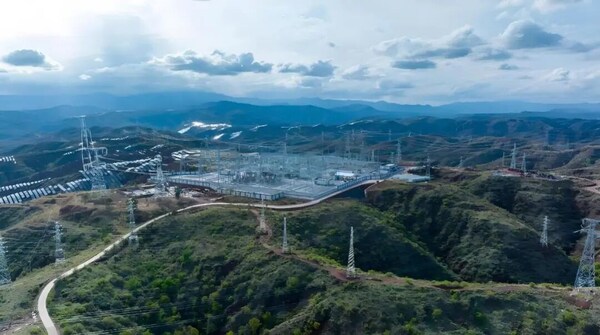
KUNMING, China, May 6, 2026 /PRNewswire/ — As a key energy hub in Southwest China, Yunnan Power Grid Co., Ltd. (Yunnan Power Grid) is tasked with large-scale clean energy transmission and smart grid development. However, the region’s complex terrain and long transmission lines have made this transformation challenging, rendering the digital and intelligent upgrade increasingly urgent. The explosion of production data and the rise of complex service scenarios further amplify this urgency, imposing ever-stricter requirements on the underlying communication bearer network.

Network Transport Challenges in the Digital and Intelligent Transformation of the Power Industry
To tackle these issues, Yunnan Power Grid has chosen SPN to drive the evolution of its next-gen bearer network, incorporating it into both the 14th and 15th Five-Year Plans. The company has progressively rolled out the technology on a large scale across 16 cities, laying a communication foundation for the next two decades. In this strategic upgrade of electric power services, Huawei has emerged as a key partner.
Dual Dividends: Ultimate Experience and Long-Term Value
Since the pilot in 2022, SPN has evolved from a technical trial to a standard architecture across Yunnan Province. With SPN now being deployed in Zhaotong and Pu’er, the full value of the next-gen bearer network is being unleashed.
First, the bandwidth bottleneck has been resolved. The next-gen SPN bearer network resolves bandwidth bottlenecks by breaking the 155 Mbit/s–10 Gbit/s capacity limit. SPN devices boost access layer (substations, power stations, customer centers) bandwidth to 1 Gbit/s, meeting China Southern Power Grid standards. Aggregation and core layers scale up to 50 Gbit/s or 100 Gbit/s based on site and service size. The solution enables 10 Mbit/s fine-granularity hard pipes for end-to-end isolation of power private lines, supporting high-bandwidth services like transmission video surveillance and ensuring smooth evolution.
Second, the bandwidth upgrade has significantly improved inspection and maintenance efficiency. Huawei’s SPN solution enables real-time SLA monitoring (latency, packet loss) and fault localization within minutes, cutting maintenance costs linked to SDH equipment failures. At Qujing Power Supply Bureau, single inspection time dropped from 30 to 3 minutes, and full-cycle maintenance from over 7 hours to 21 minutes. The O&M center now detects major defects 15 days earlier via preset monitoring points. Over six months, site visits fell from 112 to 61—a 45.54% reduction.
Third, the intelligence level of service transport has been greatly improved. Huawei’s SPN solution supports diverse electric power services—from latency-sensitive teleprotection and dispatching to high-traffic video—with reliable transmission. Using FlexE hard and soft slicing, it ensures rigid isolation between services while enhancing bandwidth reuse. IPv4/IPv6 dual stack enables flexible local forwarding and easy IoT access, such as transmission line monitoring and source-grid-load-storage integration.
Finally, SPN provides long-term investment protection. The evolution to 25 Gbit/s to 400 Gbit/s rates can be supported through low-cost upgrades, avoiding repeated construction.
For detailed solutions, please visit our official website:
https://e.huawei.com/en/case-studies/industries/grid/202604-yunnan-power-grid-spn