

 |
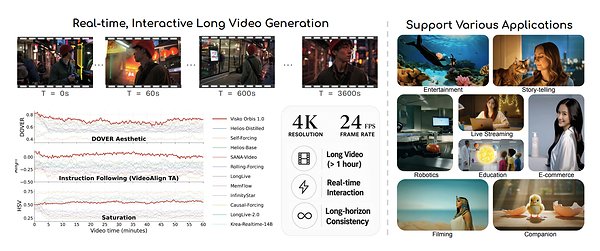
Orbis streams interactive 4K video at 24 frames per second, responds to user intervention instantly, and sustains hour-scale generation without evident visual or color drift.
SUNNYVALE, Calif., Sept. 1, 2026 /PRNewswire/ — Visko, the AI research company behind Live Models, today announced a $10 million pre-seed round of fundraising and opened public access to Orbis — the foundation model that creates living worlds and streams them in real time, with persistent memory, interactivity, and physics-grounded generation of unbounded length.
Most AI video generators work offline: a user submits a prompt, waits, and receives a finished clip that cannot be changed. Visko’s models belong to a class the company calls Live Models — models that run rather than render. Orbis generates video continuously and in real time. Users can change the prompt at any moment during generation and see the update reflected instantly while the video keeps streaming.
According to the company’s technical report, Orbis delivers 4K video at 24 frames per second in real time and sustains hour-scale generation without evident quality or color drift. Generation is grounded in physical dynamics: a latent world model scores candidate futures during inference, steering output toward physically plausible motion and object dynamics.

Overview of Visko Orbis 1.0 as a real-time, interactive long-video generation system. (Provided by Visko)
In the report’s evaluations, Orbis leads compared real-time and long-video systems on DOVER aesthetic and technical quality and on VideoAlign visual and motion quality, and records the highest overall-preference and temporal-stability ratings in the report’s long-form human preference study across eight systems. The report also discloses dimensions where Orbis trails other systems, with full methodology and results published.

Top: Quality, alignment, and motion measurements on one- to three-minute event-based benchmark. Bottom: Overall long-form video Arena point estimates from the human preference study. VISKO Orbis 1.0 obtains the highest overall score; The table provides the dimension-level comparison and citations for all baselines. (Provided by Visko)
“Every real-time system before this faced the same wall: the longer a world runs, the more it falls apart. We built Orbis to hold together — physically, visually and narratively — for as long as you want to stay inside it. Starting today, anyone can see that for themselves at visko.ai,” said Qing (Will) Yin, founder and chief executive officer of Visko.
Dr. Michael I. Jordan from UC Berkeley, the Chairman of the Advisory Board of Visko, comments, “Visko is pursuing one of the most ambitious directions in video AI: live, stateful models that continuously perceive, predict, and interact with the world in real time while maintaining physical consistency. Visko delivers a state-of-the-art architecture that has a meaningful technological lead beyond conventional short-clip video generation. The same core capability could support a remarkably broad range of commercial opportunities, from robotics and physical simulation to gaming, live commerce, education, and real-time creative media.”
Visko was founded in 2025 by Qing (Will) Yin, a Stanford Ph.D. in Computational Mathematics and Mechanics who spent three years as a researcher at Apple. The company’s 16-person team draws from Apple, Google DeepMind, Meta, Amazon, and Tesla, and is advised by Michael I. Jordan of the University of California, Berkeley; Steve WaiChing Sun of Columbia University; and academic partner, Mengye Ren of New York University. Distribution is handled through Visko’s partner Reactor.
About Visko
Visko is an AI research company pioneering Live Models — a new class of world models that run rather than render. Where conventional AI video generates a clip and stops, Visko’s foundation model, Orbis, simulates a world and streams it live: physics-grounded, interactive, with persistent memory and no fixed length. The company’s thesis is that the next paradigm of AI is not a model you call, but a process that runs in step with the world itself. Founded by Stanford Ph.D. and former Apple researcher Qing (Will) Yin, Visko is headquartered in Sunnyvale, California, and has raised $10 million led by Llama Ventures. Learn more at visko.ai.