

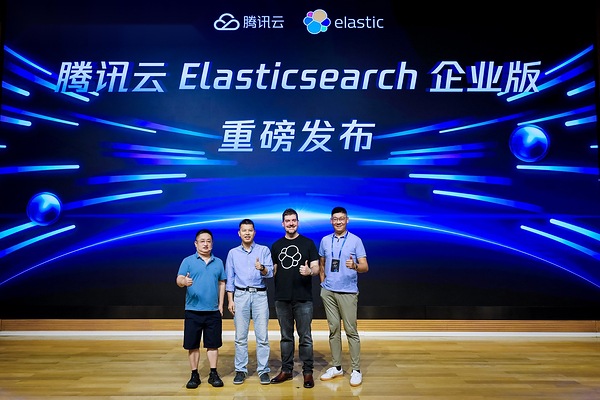
SHENZHEN, China, Aug. 31, 2026 /PRNewswire/ — Tencent Cloud, the cloud business of global technology company Tencent, and Elastic announced an expanded strategic collaboration in Shenzhen. The companies will deepen their technical and product collaboration across AI search, enterprise data, and agentic applications, helping enterprises establish dedicated context infrastructure for the AI era.

The two companies also jointly launched Tencent Cloud Elasticsearch Service (ES) Enterprise Edition, which introduces Elastic’s enterprise-grade search and AI capabilities to the platform.
Elasticsearch is one of the world’s most widely used open-source search engines. Elastic’s Search AI Platform, the foundation for its search, observability, and security solutions, is used by thousands of companies, including more than 50% of the Fortune 500. It supports tasks such as product search in e-commerce, in-app search, and the troubleshooting and analysis of system logs. Tencent Cloud has been offering cloud services based on Elasticsearch since 2016.
AI is fundamentally changing the role of enterprise search, serving as the essential bridge that retrieves real-time context from internal data to ground large language models (LLMs). These models do not inherently understand an enterprise’s internal information. To answer business questions, they need to retrieve relevant content from enterprise data in real time. Agents also need to continuously locate information and tools as they carry out tasks. Search is becoming a way to provide AI systems with grounded enterprise data.
Patrick Dixon, Senior Director of Channels & Alliances for APJ and Vice President for China at Elastic, said that as large language model capabilities advance, context is becoming increasingly important to enterprise AI applications. For agents, the ability to locate accurate and reliable enterprise data when it is needed directly affects the quality of subsequent responses, decisions, and execution.
Tencent Cloud Elasticsearch Service (ES) Enterprise Edition strengthens AI search, model integration, and agent connectivity. Enterprises can combine keyword and semantic search, enable large language models and agents to call search results directly, and keep large volumes of historical data searchable to provide AI with more complete business context.
Alongside Elastic’s native capabilities, Tencent Cloud has continued to enhance ES with in-house engineering. In selected AI search scenarios, performance has improved by up to 5x, hybrid search latency has fallen by 60%, and memory consumption has been reduced by more than 50%.
Enterprises can add AI search capabilities without changing their existing data architecture and can use the service together with Tencent Hunyuan large language models and the Tencent Cloud TCRay inference platform. Customers running open-source editions or self-managed clusters can also access technical migration and upgrade services.
Enterprises are already leveraging these advanced search capabilities to optimize their AI and security workflows. Tencent ima uses ES as the underlying retrieval layer for its knowledge base, supporting both keyword and semantic search. After Tencent Cloud optimized the system for many users searching the knowledge base concurrently, memory consumption fell by 71% and retrieval performance improved by 58%.
At NIO, Tencent Cloud Elasticsearch Service (ES) serves as part of a security data intelligence foundation. It identifies the information most relevant to a current event from large volumes of security data, which AI then analyzes further. The system processes hundreds of billions of records in a single quarter. In one real-world attack, an attack chain that previously took analysts most of a day to investigate manually can now be retrieved and reconstructed in just two minutes.
Cheng Bin, General Manager of Data Platform Products at Tencent Cloud Data Analytics, said, “AI search is evolving from a standalone retrieval capability into infrastructure that connects enterprise data, models, and agentic applications. Tencent Cloud will combine Elastic’s enterprise-grade capabilities with its own experience in operating large-scale systems and its AI ecosystem, helping more enterprises establish context infrastructure for the AI era.”
Han Xiao, Vice President of AI at Elastic, said that as large language models turn toward longer-horizon tasks in 2026, search has more room to contribute. “Search in 2026 is, in essence, about test-time compute.” He added, “When search quality falls short, teams should first consider whether additional inference compute can address the problem before adding data or switching to a larger model.”
Tencent Cloud was among the early cloud providers in China to form a Platinum-level partnership with Elastic. Over the past seven years, Tencent Cloud has consistently ranked among the leading contributors to the Elastic open-source community. Tencent Cloud Elasticsearch Service (ES) now runs 20,000 clusters and 100,000 nodes, reliably supporting search traffic peaks for large-scale live events, including the China Media Group (CMG) Spring Festival Gala and the Paris Olympic Games.
About Tencent Cloud
Tencent Cloud is one of the world’s fastest-growing cloud service providers, committed to delivering innovative solutions that address everyday life and business challenges, and empowering the digital transformation of smart industries. Tencent Cloud has always upheld its mission to meet the needs of diverse industries, leveraging cloud computing, big data analytics, AI, IoT and cybersecurity, together with its extensive global infrastructure, to provide businesses with stable, secure, and industry-leading cloud products and services across a wide range of sectors, including education, finance, healthcare, gaming, media and entertainment, property, retail, travel, and transportation.