

 |
DALIAN, China, June 25, 2026 /PRNewswire/ — The 17th Annual Meeting of the New Champions kicked off in Dalian, China, from June 23 to 25, 2026. Under the theme “Innovating at Scale,” the event brings together over 1,700 political, business, academic, and innovation leaders from more than 90 countries to engage in in-depth dialogues on the global economy, climate action, and cutting-edge technologies.
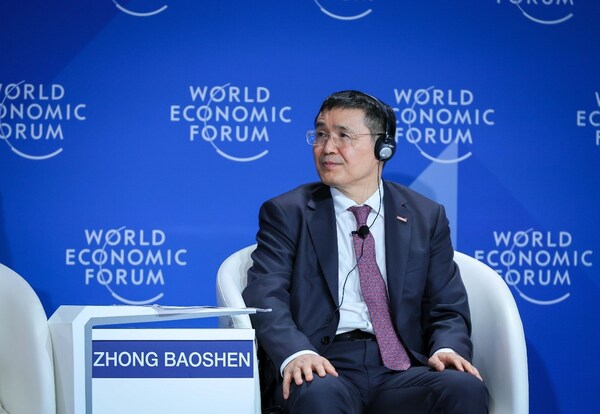
During the meeting, Zhong Baoshen, Chairman and General Manager of LONGi, took part in the roundtable dialogue titled “Follow the Money: Where Climate Capital Is Going,” where he shared his perspectives on the decarbonization potential of Solar-Plus-Storage integration and the metrics for measuring the effectiveness of clean energy investments.

Zhong Baoshen, Chairman and General Manager of LONGi, took part in the roundtable dialogue titled “Follow the Money: Where Climate Capital Is Going,” where he shared his perspectives on the decarbonization potential of Solar-Plus-Storage integration and the metrics for measuring the effectiveness of clean energy investments.
Zhong Baoshen believes that developing renewable energy is not only an urgent necessity for addressing climate change, but also a strategic choice for driving local economic growth and achieving energy independence. Photovoltaic (solar) and wind power are more widely distributed than oil and gas, and this characteristic enables them to benefit all regions more equitably, effectively enhancing strategic energy autonomy. From the perspectives of energy resilience, security, and economic viability, the development of renewable energy is highly advantageous for boosting local economies.
Over the past 15 years, the cost of photovoltaic (solar) power generation has fallen by more than 90%, driven entirely by technological progress, to which Chinese companies have made tremendous contributions. It is precisely this continuous innovation that has made it possible for renewable energy to benefit the world at large.
Zhong Baoshen pointed out that the core challenge facing the industry today lies in the bottlenecks to expansion caused by grid integration and absorption, as well as the intermittency of solar power. However, the key variable to break through this bottleneck is maturing — the sharp decline in energy storage costs enables us to build a truly renewable energy system. Through the integration of photovoltaic (solar), wind power, and energy storage, it has become feasible to rely entirely on renewable energy to support power systems.
Based on this trend, Zhong Baoshen shared with the attendees LONGi’s development approach of “Solar-Plus-Storage Integration”: on the photovoltaic (solar) front, LONGi will continue to improve conversion efficiency and reduce costs, while promoting deep integration of photovoltaic (solar) with buildings, transportation, and other scenarios; on the storage side, the focus is on developing solar-plus-storage integration to effectively store green electricity and dispatch it on demand, ultimately making renewable energy economical, convenient, and reliable — capable of meeting living and working needs in any scenario. Realizing this blueprint also requires technological innovation support in areas such as power generation forecasting, energy management, and grid dispatching. Encouragingly, these fields are thriving globally, and the conditions for large-scale deployment of clean energy as a backbone power source for the grid are becoming increasingly mature.
Beyond technological pathways, how capital and policy can remove barriers to scaled deployment is a more pragmatic issue. Addressing the capital bottlenecks in global renewable energy deployment, Zhong Baoshen pointed out that differences in financing costs across regions directly affect the speed of clean energy adoption. Therefore, he called on the international community to join forces with insurance institutions, public welfare organizations, and other stakeholders to innovate collectively, helping to lower interest rates in high‑financing‑cost regions and enabling renewable energy to truly gain development opportunities locally. He suggested that in developed areas, granting green energy priority in development, or recognizing its green value so that projects can obtain reasonable returns, would be highly beneficial for clean energy deployment.
China is currently promoting the assumption of carbon reduction responsibilities by relevant parties, which essentially gives green energy priority. From the corporate perspective, LONGi has developed a range of diversified products, including microgrid systems combining photovoltaics and energy storage, distributed energy systems equipped with intelligent forecasting and dispatching, and photovoltaic water‑pumping solutions implemented in arid regions of Central Asia and Africa, continuously adapting to the needs of different scenarios.
By clearing the path through technological breakthroughs on one hand, and removing barriers through capital and policy on the other — advancing on both fronts — the scaled deployment of clean energy can truly accelerate. Zhong Baoshen stated that as finance, insurance, and society at large provide more support to green energy, and as companies continue to launch competitive and innovative products, the overall deployment of clean energy will certainly accelerate, and our capacity to address climate change will grow stronger.