

HONG KONG, March 27, 2026 /PRNewswire/ — Unisound (09678.HK) announced its audited annual results for the year ended December 31, 2025. As the Company’s first annual results announcement since listing, it underscores strong growth momentum and continued improvement in its financial profile.
Revenue Mix Continues to Improve, with Faster Growth in H2
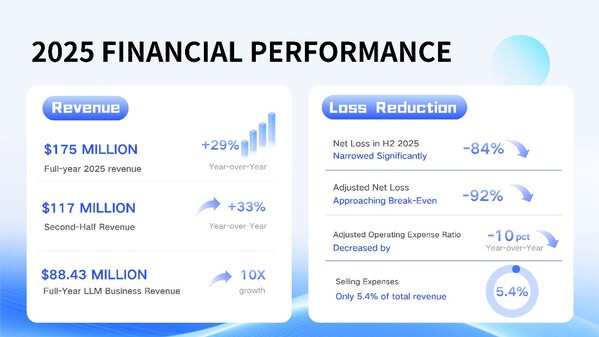
For the full year of 2025, Unisound achieved total revenue of $175 million, representing a year-on-year (YoY) increase of 29%. Revenue in the second half of the year increased by 33% YoY to $117 million.
It is worth noting that the Company’s large language model (LLM) business generated a full-year revenue of $88.43 million, surging by over 10 times YoY. In particular, this business contributed approximately $72.49 million in H2 revenue, five times the level recorded in H1, demonstrating a compelling capacity for large-scale commercial application.
Losses Narrowed Significantly, Making the Path to Profitability Increasingly Clear
Alongside the rapid revenue growth, the Company’s losses improved markedly. In the second half of 2025, the Company’s net loss narrowed by 84% YoY, and its adjusted loss narrowed by 92% YoY, approaching break-even. This reflects the Company’s ongoing improvements in cost control and operational efficiency.
Simultaneously, some of the Company’s operating metrics saw marked improvement. The adjusted expense ratio declined significantly by 10 percentage points YoY, while selling expenses decreased rather than increased and accounted for only 5.4%, highlighting a clear improvement in cost-to-efficiency ratio. In 2025, revenue per employee reached $365,300, up 25% YoY from $292,900 in 2024. Employee productivity continued to lead the industry, clearly underscoring the Company’s core strengths in technology-driven, lean operations.

Dual-Engine Strategy Gains Traction, with AI in Healthcare and AI in Daily Life Advancing in Tandem
In 2025, driven by both technological breakthroughs and policy tailwinds, global demand for AI continued to rise. Unisound adhered to its “Strong Foundation Model + Deep Application” strategy, continued to strengthen its multimodal technology foundation, and drove the continuous elevation of the global influence of its proprietary large model matrix in fields such as healthcare, speech, and OCR.
On the commercialization front, the Company leveraged its AI-native organization to accelerate business execution, and its dual-engine strategy in AI in Healthcare and AI in Daily Life delivered notable results. During the reporting period:
The AI in Daily Life business achieved revenue of $140 million, a YoY increase of 30.8%. Among this, the Transportation segment recorded nearly 40% YoY growth. At present, AI agent applications based on the Shanhai large model have been deployed in more than 10 cities, including Qingdao, Ningbo, Shenzhen and Nanning. In addition, cumulative AI chip shipments exceeded 110 million units, further validating the Company’s scale capabilities in endpoint AI products.
The AI in Healthcare business achieved revenue of $35.38 million, a YoY increase of 22.3%, with average revenue per customer growing by 53.2% YoY. In 2025, over 70% of the hospitals the Company collaborated with were tertiary hospitals, and more than one-third of customers had maintained continuous cooperation for over three years. The medical-record entry and generation products powered by the medical large model delivered a 10-fold YoY increase in full-annual medical record generation at a single campus of a leading Class III hospital. The commercial insurance AI agent platform recorded a 37-fold YoY increase in case processing volume. In deep cooperation with a leading insurance group, the expense control rate was effectively raised to approximately 20%, delivering more than $145 million in incremental cost management compared with traditional review methods, comprehensively empowering insurance institutions to refine their medical risk management operations.
Continued R&D Investment Strengthens the Technology Moat
To consolidate its industry-leading position, the Company continued to invest heavily in R&D in 2025. Full-year R&D expenses exceeded $55.09 million, accounting for 75% of the Company’s adjusted operating expenses, while R&D personnel accounted for 69% of the total workforce. This sustained investment drove breakthroughs across multiple technology areas. For example, in the MedBench 4.0 evaluation, the Company ranked first place in three technical paradigms: “Medical AI Agent,” “Medical Large Language Model,” and “Medical Multimodal Large Model,” earning a “Triple Crown.”
Outlook: Deepening the Technological Foundation and Expanding Application Boundaries
Looking ahead, Unisound will continue to deepen its “Strong Foundation Model + Deep Application” strategy. On the technological front, the Company will continue to increase strategic investment in foundational large models and strive to maintain a world-class level. On the application front, it will use the large-scale expansion of MaaS (Model-as-a-Service) and AI agents as its core growth engine, driving exponential growth in its AI in Daily Life and AI in Healthcare businesses. Meanwhile, the Company is actively exploring the establishment of a recurring revenue system through models such as API calls and Token-based billing, and regards opportunities in consumer-facing (C-end) products as a second growth curve to further expand its commercialization boundaries.
Between Q2 and Q3 2026, Unisound will launch a native AI agent large model for programming and office applications, which is expected to double both intelligence density and token production efficiency.