
HONG KONG, Jan. 30, 2026 /PRNewswire/ — SUEZ has been awarded the contract for supplying sludge dewatering solution for the Relocation of Sha Tin Sewage Treatment Works to Caverns by the Drainage Services Department (DSD) of Hong Kong SAR Government. The project will be delivered by SUEZ, leveraging a sludge dewatering technology developed and continuously improved over more than 15 years through SUEZ’s collaboration with Bucher Unipektin AG[1]. This sludge dewatering contract covers design, equipment supply and delivery for the new Sha Tin Cavern Sewage Treatment Works (STCSTW).

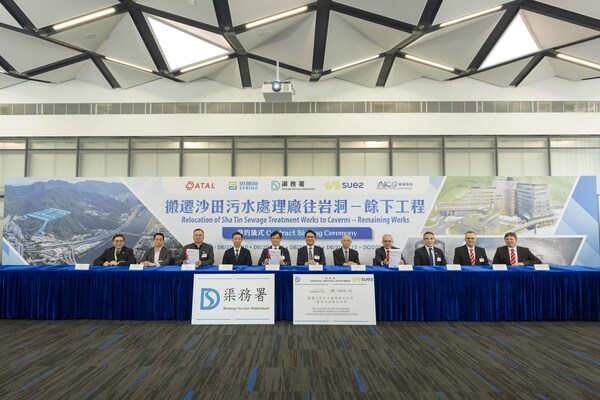
On 27 January 2026, SUEZ was awarded the sludge dewatering project for the “Relocation of Sha Tin Sewage Treatment Works to Caverns” by the Drainage Services Department (DSD) of Hong Kong SAR Government (Image by the Drainage Services Department of Hong Kong SAR Government)
Scheduled for completion in 2030, the new facility is set to become one of Asia’s largest sewage treatment plants built inside an artificial cave. With its compact design and advanced process standards, the STCSTW will optimise land use and set a new benchmark for sustainable, green infrastructure in Hong Kong.
New cavern-based wastewater facility to support sanitation needs and relieve land pressure
The existing Sha Tin Sewage Treatment Works has served approximately 700,000 residents for over 40 years. As the facility needed modernisation works, the DSD has decided not only to address the challenge of aging facilities, but also to tackle the acute land scarcity issue and to improve surrounding community environment.
The DSD initiated the relocation of the Sha Tin Sewage Treatment Works into a purpose-built cavern, comprising a 14-hectare site and an upstream sewage collection system. This strategic move allows major benefits for the Hong Kong population: It will limit olfactory nuisance as caverns act as natural barriers that contain and attenuate odours. Furthermore, inside the cavern, odour sources will be enclosed and dedicated de–odourisation facilities will be installed. It will free up 28 hectares of surface land for other beneficial uses.
Long-term technology collaboration between SUEZ and Bucher Unipektin AG supporting cavern operations in Hong Kong
Recognising the constraints of cavern-based facilities, including limited space, controlled access and strict safety requirements, SUEZ will equip the project with 16 units of its proven Dehydris™ Twist sludge dewatering system. Fully enclosed and highly automated, this system supports safer operations in confined areas and helps reduce operator exposure. Its compact design reduces footprint by 25% and offers greater flexibility to allocate other essential equipment within the caverns.
Dehydris™ Twist sludge dewatering solution has proven to be stable and reliable across SUEZ projects in France, Italy, Australia, and the Chinese Mainland. In Hong Kong, seawater flushing for about 85% of the population increases sewage salinity, typically reported around 5,000 – 6,000 mg/L, which can influence dewatering performance.
To confirm results under local conditions, Dehydris™ Twist was piloted in Hong Kong for several years. The trials showed consistent performance, raising sludge solid from around 3% to no less than 30%, reducing sludge volume and associated transport and disposal costs. The system is expected to produce about 120,000 tonnes of dewatered sludge annually, supporting energy recovery and Hong Kong’s circularity and carbon reduction goals.
Commenting on the long-term technology collaboration supporting this project, Daniel Schneider, CEO Bucher Unipektin AG, said: “The implementation of Bucher HPS Technology at the new STCSTW as part of the SUEZ Dehydris™ Twist workshop marks a significant milestone in acknowledging the growing need for advanced biosolids dewatering solutions. Our technology sets new standards in efficiency and sustainability, demonstrating what is now achievable in modern wastewater treatment. There is no doubt that this innovation will play a pivotal role in supporting sustainable and economically efficient development, both in the rapidly expanding markets of Southeast Asia and across the rest of the world.”
Pierre Pauliac, Executive Vice-President of SUEZ, in charge of international activities, said: “This project is an important opportunity for SUEZ to deliver its core sludge dewatering solution for the new cavern-based treatment plant, integrating our global expertise to create local value for Hong Kong. In the Greater Bay Area, we have been committed for decades to providing sustainable environmental solutions: operating two wastewater treatment plants in Hong Kong to improve the water environment; providing quality drinking water services to the entire city of Macao; and supporting industries in Guangdong with advanced wastewater treatment solutions for its green transition. Going forward, we will continue to leverage our expertise in water and waste, working closely with all stakeholders to drive the Greater Bay Area towards a greener, more resilient, and sustainable future.“
|
[1] Bucher Unipektin AG, a subsidiary of Bucher Industries |
About SUEZ:
Faced with growing environmental challenges, SUEZ has been delivering essential services that protect and improve our quality of life for more than 160 years. SUEZ provides its customers with innovative and resilient solutions for water and waste services. With 40 000 employees across 40 countries, the Group works with customers to create value over the full lifecycle of their assets and services, and to drive their low carbon transition. In 2024, SUEZ provided drinking water for 68 million people worldwide and sanitation services for 44 million people. The Group generated 8 TWh of energy from waste and wastewater. In 2024, SUEZ has generated revenues of 9.2 billion euros. For more information: www.SUEZ.com.
In Asia, SUEZ’s journey began some 70 years ago, first in Southeast Asia before expanding to China 50 years ago. With over 6,500 employees across Asia, SUEZ has built more than 600 water and wastewater treatment plants. Today, SUEZ works with municipal and industrial customers in more than 30 major cities and regions, providing water and waste recycling and recovery services to 25+ million people and 23 industrial parks.