

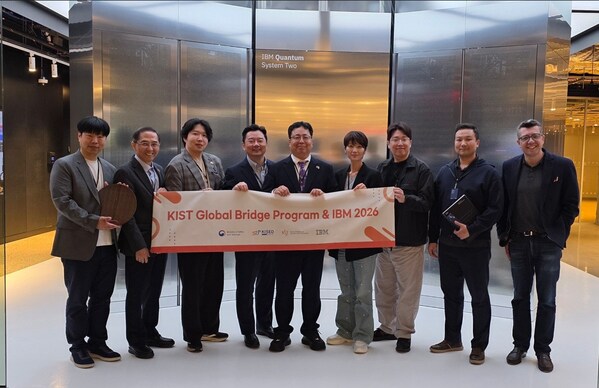
SEOUL, South Korea, May 8, 2026 /PRNewswire/ — A Korean quantum delegation led by the Korea Institute of Science and Technology (KIST) is strengthening global collaboration in quantum technologies through a strategic visit to the IBM Thomas J. Watson Research Center in New York.

KIST-led Korea Quantum Delegation with IBM researchers
Supported by the Ministry of SMEs and Startups (MSS) and organized by the Korea Institute of Startup & Entrepreneurship Development (KISED) under the “Deeptech Incubator Project for Startups (DIPS)” program, the initiative aims to accelerate the global technology commercialization of South Korea’s quantum startups.
As the lead institution for this sector, KIST utilized its Global Bridge Program—developed in collaboration with IBM—to facilitate direct technical exchanges between IBM researchers and startup founders. These sessions allowed participants to identify concrete pathways for partnerships and gain insights into the latest quantum trends, laying the groundwork for joint research, proof-of-concept (PoC) projects, and future commercialization.
The IBM Thomas J. Watson Research Center is a key hub for IBM Quantum, driving global innovation across quantum hardware, software, algorithms, and cloud-based quantum services. During this visit, the delegation also gained firsthand insight into IBM’s quantum computing roadmap and industrial application strategies, while exploring potential areas of collaboration within the global quantum ecosystem.
In particular, Representatives of the Korean quantum startups engaged in a strategic technology exchange session with George Tulevski, Program Director at IBM Research Think Lab, centered on the architecture and operational framework of the “IBM Quantum System Two.” Discussions further addressed the evolving global quantum ecosystem, industrial commercialization pathways, and opportunities for cross-border collaboration in quantum technologies.
The delegation consisted of five quantum startups, along with participants from Kyung Hee University’s Department of Advanced Business and related ventures, forming a Korean Quantum Delegation led by KIST.
By integrating research institutions, academia, and startups, the delegation represents a comprehensive ecosystem that connects technology development, commercialization, and global expansion.
The participating startups reflected the breadth and diversity of South Korea’s growing quantum technology ecosystem. These include QUAD, specializing in superconducting nanowire single-photon detector (SNSPD) technology for quantum communication and defense; OptiQ-Labs, which develops laser-based optical modules to address bottlenecks in ion-trap systems; SLEEX, focused on combining Quantum LiDAR with electric field sensing for underwater navigation; Elixir developing StatUpAI, specializes in quantum-classical hybrid algorithms for data analysis and AI modeling, particularly for medical clinical trials; and SQK (QMEDIC), which develops physics-constrained medical imaging AI solutions for enhanced CT and MRI reconstruction.
SunJoon Kang, Program Director at KIST, stated, “This visit to the IBM Watson Research Center is a pivotal milestone that enables Korean startups to align directly with the frontiers of global innovation. Under the DIPS initiative, we are committed to forging strategic alliances that will accelerate the transition of quantum technology from the lab to the global marketplace.”
Meanwhile, this collaboration is expected to continue beyond the facility visit. On May 19, the “IBM Quantum Connect APAC: Seoul” event will be held at Conrad Seoul, bringing together IBM Quantum leaders and technical experts to discuss industrial applications and global collaboration models for quantum computing. Key topics will include IBM’s technology roadmap, quantum algorithm applications, and strategies for building global quantum ecosystems.
These continued engagements are expected to further strengthen the connection between South Korean startups and the global quantum ecosystem, enabling future joint research and commercialization opportunities. The KIST Global Bridge Program, in collaboration with IBM, is a catalyst for the global market expansion of South Korea’s quantum industry.
To take part in the IBM Quantum Connect APAC: Seoul, visit https://www.ibm.com/events/reg/flow/ibm/0ul5hwmb/landing/page/landing or learn more about KIST at https://kist.re.kr/
About KIST
KIST was established in 1966 as the first government-funded research institute in South Korea. KIST now strives to solve national and social challenges and secure growth engines through leading and innovative research.
About Participating Quantum Startups
QUAD, led by Chief Executive Officer Byung Doo Oh, develops quantum sensing technologies based on superconducting nanowire single-photon detectors (SNSPDs), offering high sensitivity and precision with applications spanning quantum communication, quantum computing, semiconductor inspection, and defense.
SLEEX led by Chief Executive Officer Je ho Lee, is developing an advanced perception technology that combines quantum LiDAR and electric field sensing to overcome limitations of existing underwater sensors, particularly by eliminating blind zones within the 0–2 meter range, with applications in autonomous navigation, maritime security, and defense. (https://www.thesleex.com)
Elixir, headed by Chief Executive Officer Jeong Kwon Jang, develops a drug discovery and biomarker analysis platform based on quantum-classical hybrid algorithms, targeting the precision medicine market through the integration of bioinformatics and quantum machine learning. (statupai.com)
SQK led by Chief Executive Officer Young Je Son, develops medical imaging AI based on quantum-physics constraints, addressing hallucination issues in conventional AI by ensuring physical consistency in CT and MRI reconstruction. The company is improving diagnostic reliability and reducing the need for re-scans in clinical settings. (www.sqkcloud.com)
OptiQ-Labs, led by Co-Founder and Chief Executive Officer Sung Jae Chung, develops compact and ultra-stable optical systems for ion-trap quantum computers, addressing key bottlenecks in scalability and integration. The company is building quantum hardware components optimized for next-generation quantum computing infrastructure, with applications spanning quantum optics, ion-trap systems, and photonic quantum hardware. (www.optiq-labs.com)