

BANGKOK, March 11, 2026 /PRNewswire/ — Social engineering attacks have become increasingly sophisticated, creating growing risks for enterprises. As email remains a primary entry point for these breaches, Coremail, with over 27 years of experience in email security, shared its insights on emerging trends. The company notes that organizations are shifting from reactive defenses toward more intelligent and structured security architectures.
Tim Lin, CTO of Coremail, said the evolution of generative AI and social engineering attacks is reshaping enterprise email security risks. Organizations therefore need a multi-layered defense framework that combines AI capabilities with governance to strengthen overall resilience.
Establishing the First Line of Defense with an LLM-Powered Email Security Gateway
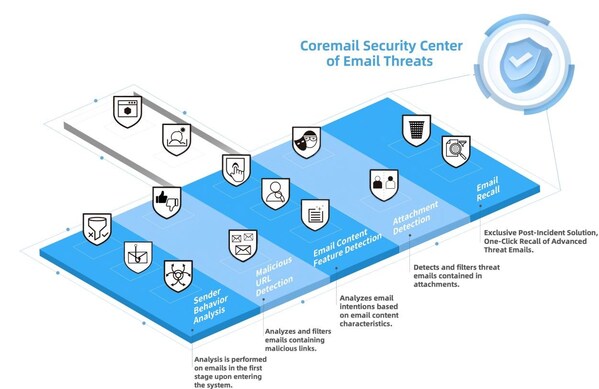
Traditional rule- and signature-based systems often struggle against evolving threats like identity spoofing and Business Email Compromise (BEC). To provide proactive protection, Coremail’s CACTER Secure Email Gateway integrates LLMs and multimodal analysis into an AI-driven defense architecture.
Leveraging key AI capabilities including deep semantic analysis, zero-shot detection, and attacker profiling, the SEG can:
- Detect and block phishing, spam, malware and covert BEC attacks
- Inspect URLs dynamically to stop malicious links
- Detect unknown and variant threats through multimodal analysis
- Provide administrators with clear threat visibility and policy recommendations
Built on a full-lifecycle security framework, the SEG enables continuous filtering and monitoring. Test results show it can block up to 99.8% of spam with a false positive rate below 0.02%, strengthening security without disrupting normal business operations.
Lowering Human Risk Through Anti-Phishing Drills
Human error remains a major cause of security incidents, as attackers exploit trust by impersonating executives. To counter this, organizations should conduct continuous, scenario-based anti-phishing drills instead of relying on one-time training.
CACTER’s anti-phishing simulation service provides customizable, real-world scenarios that help employees identify suspicious requests. Regular simulations significantly reduce mistakes and help prevent security incidents at their source.
Strengthening Governance and Security Awareness
Beyond technical safeguards, strong governance is essential. Companies should enforce the principle of least privilege, strengthen access control, and adopt multi-factor authentication to mitigate account misuse. Regular training and clear compliance responsibilities help embed security awareness into daily operations, enabling a shift from reactive risk management to proactive prevention.
As internal and external threats converge, a single layer of protection is no longer sufficient. By combining AI-driven gateways, employee preparedness and stronger governance, enterprises can better protect their operations.
For more information, please visit: coremail.co.th