
 |
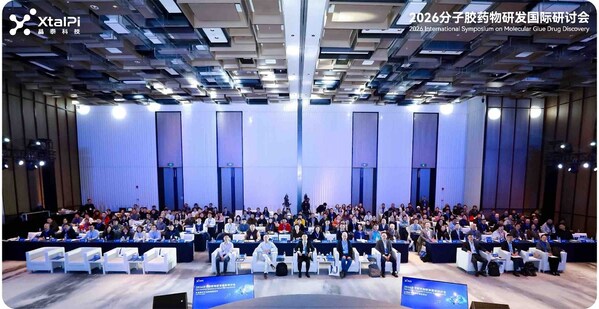
- Global thought leaders presented cutting-edge research at the 2026 International Symposium on Molecular Glue Drug Discovery.
- XtalPi unveils the AI-driven XGlue™ platform to enable rapid, closed-loop molecular glue drug discovery.
- Cross-sector discussions emphasized the need for bridging gaps between academic research, industrial development, and clinical applications.
SHANGHAI, Jan. 29, 2026 /PRNewswire/ — Recently, XtalPi, a global leader in AI- and robotics-powered drug discovery, successfully concluded its 2026 International Symposium on Molecular Glue Drug Discovery. The event convened leading scientists, biopharma innovators, entrepreneurs, and investors from around the world to explore how emerging technologies are redefining strategies for historically “undruggable” protein targets.

XtalPi successfully concluded its 2026 International Symposium on Molecular Glue Drug Discovery
Molecular glue discovery has long relied on serendipity. In his opening remarks, XtalPi Co-founder and CEO Dr. Jian Ma emphasized the need for a fundamental paradigm shift—moving from chance-based discoveries toward a systematic, technology-driven approach enabled by AI, robotics, and global collaboration.
Anchoring this transition, XtalPi Vice President Dr. Yang Xie introduced the company’s proprietary XGlue™ platform. XGlue™ integrates physics-based AI modeling to interrogate complex protein–protein interactions with an agentic AI–controlled autonomous synthesis workflow. This closed-loop design–make–test system enables rapid iteration and significantly expands the addressable target space for molecular glue therapeutics, positioning XtalPi at the forefront of next-generation protein degradation.
The symposium featured a series of scientific presentations highlighting the evolution of the field. Prof. Nathanael S. Gray (Stanford University) and Prof. Bruno Correia (EPFL) discussed leveraging chemically induced proximity and computational de novo design to uncover functional interactions beyond the reach of traditional drug discovery. Prof. Ke Ding (Chinese Academy of Sciences) and Dr. Yong Cang (ShanghaiTech University) presented compelling examples of rationally discovered and designed molecular glues addressing critical diseases with significant unmet medical need. Dr. Jianwei Che (Dana-Farber Cancer Institute) and Dr. Liqiang Fu (GluBio) further highlighted how AI-driven methodologies and enabling technologies are improving target selectivity, enhancing molecular potency, and strengthening the safety profile of glue-based therapeutics. From an investment and commercialization perspective, Mr. Peter Zhang (YAFO Capital) outlined strategic pathways for scaling molecular glue therapies across global markets.
The symposium concluded with a cross-sector roundtable on building a sustainable innovation ecosystem for protein degradation. Moderated by Dr. Yang Xie, the discussion brought together leaders from Sanofi, Betta Pharma, GluBio, and other organizations to address the critical gaps between academic discovery, industrial development, and clinical translation. A shared consensus emerged: sustained progress in protein degradation will require deep integration across science, industry, and capital.
As molecular glue therapeutics continue to gain momentum, the convergence of predictive AI and high-throughput automation is accelerating a shift toward logic-driven drug discovery—transforming once-intractable biological targets into viable therapeutic opportunities.
About XtalPi
XtalPi Holdings Limited (XtalPi, 2228.HK) was founded in 2015 by three physicists from the Massachusetts Institute of Technology (MIT). It is an innovative R&D platform powered by quantum physics, artificial intelligence, and robotics. By integrating first-principles calculations, AI algorithms, high-performance cloud computing, and standardized automation systems, XtalPi provides digital and intelligent R&D solutions for companies in the pharmaceutical, materials science, agricultural technology, energy, new chemicals, and cosmetics industries.