
 |
ISTANBUL, Jan. 22, 2026 /PRNewswire/ — Beko, the leading global home appliance company, today unveiled its proprietary Smart Living Index (SLI). The study revealed that financial pressures are now the biggest driver of adoption of sustainable household behaviours worldwide.

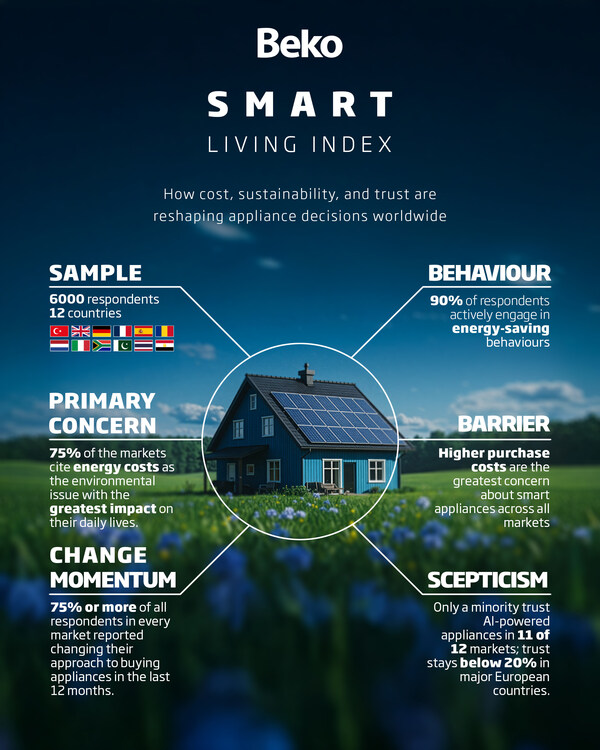
Beko Smart Living Index
One of the largest studies of its kind, the Smart Living Index tracks how consumers’ views of sustainability and energy use are evolving. The study also looks at how consumers are using smart appliances within their own homes.
For the Smart Living Index, Beko surveyed a representative sample of 6,000 consumers across 12 markets – the UK, Germany, France, Spain, Italy, the Netherlands, Romania, Turkey, Egypt, Thailand, Pakistan and South Africa.
Consumers in every market reported changes in their approach to buying appliances in the past 12 months, with long-term affordability and sustainability increasing in importance as considerations.
In markets where consumers are actively tracking the running costs of appliances, adoption of smart features was higher. Conversely, markets that do not track energy usage so closely are slower to adopt smart features and instead turn to other energy-saving activities such as drying laundry on a washing line, or hand-washing dishes.
Key findings:
- Cost as catalyst: 8 out of 12 markets cite energy costs as the environmental concern with the greatest impact on their daily lives, reflecting how climate and sustainability challenges are most acutely felt through household energy bills.
- Global South leads the way: In western markets such as the UK, Germany, and France, consumers place less value on smart living compared to emerging markets like Egypt, Thailand and Pakistan.
- Trust gap in technology: Fewer than 20% of consumers in key European markets (France, Spain, UK, Germany) trust AI-powered appliances, despite widespread recognition that smart appliances benefit the environment.
- Going analogue: A huge proportion of the public engage in appliance substituting behaviour to save energy at home – for example, in many countries around two-thirds of respondents signaled that they dry laundry on a line.
- The age vs. income paradox: Energy-saving activity increases with age, but decreases with income, defying conventional assumptions about environmental engagement. The over-54 age group leads across all energy-saving behaviours.
- Demand for government support: Over 50% of respondents from all markets agreed that government policy should support consumers as they switch to more resource-efficient home appliances rather than leaving the transition entirely to households.
- The future is smart: Thailand (81%), Pakistan (86%) and Turkey (80%) show most enthusiasm for appliances to become even smarter, with Germany (39%), the UK (40%) and France (43%) placing less focus on smart innovation. However, countries are united in being most excited by innovations that are self-cleaning or energy-generating.
Commenting on the launch of the Smart Living Index, Hakan Bulgurlu, Chief Executive Officer at Beko, said: “The Smart Living Index highlights the urgent need to bridge the trust gap in smart technology and its benefits to unlock its full potential for smarter, more sustainable living in every household. The findings also show how small, individual changes – when adopted at scale – can create significant collective impact. At Beko, we believe that consumers should have access to options designed to reduce environmental impact, regardless of financial pressures. By understanding global energy-saving trends and perceptions of smart appliances, we are even more equipped to meet the needs of our customers and support the shift toward more sustainable living.”
About Beko
Beko is an international home appliance company with a strong global presence, operating through subsidiaries in more than 55 countries with a workforce of over 50,000 employees and production facilities spanning multiple regions — including Europe, Asia, Africa, and the Middle East. Beko has 22 brands owned or used with a limited license (Arçelik, Beko, Whirlpool*, Grundig, Hotpoint, Arctic, Ariston*, Leisure, Indesit, Blomberg, Defy, Dawlance, Hitachi*, Voltas Beko, Singer*, ElektraBregenz, Flavel, Bauknecht, Privileg, Altus, Ignis, Polar). Beko became the largest white goods company in Europe with its market share (based on volumes) and reached a consolidated turnover of 10.6 billion Euros in 2024. Beko’s 28 R&D and Design Centers & Offices across the globe are home to over 2,300 researchers and hold more than 4,500 international registered patent applications to date. The company has achieved the highest score in the S&P Global Corporate Sustainability Assessment (CSA) in the DHP Household Durables industry for the seventh consecutive year (based on the results dated 16 October 2025).** The company has been recognized as the 17th most sustainable company on TIME Magazine and Statista’s 2025 list of the World’s Most Sustainable Companies. Beko’s vision is ‘Respecting the World, Respected Worldwide.’
*Licensee limited to certain jurisdictions.
**The data presented belongs to Arçelik A.Ş., a parent company of Beko.
About Beko’s Smart Living Index
The Beko Smart Living Index (SLI) is the first of its kind — a comprehensive global study examining how consumers view and adopt sustainable home living and smart appliance technology. Developed to provide actionable insights for industry, policymakers, and media, the Smart Living Index explores how financial pressures, generational shifts, and cultural differences are shaping household behaviours worldwide.
The study surveyed 6,000 respondents across 12 markets — the UK, Germany, France, Spain, Italy, the Netherlands, Romania, Turkey, Egypt, Thailand, Pakistan, and South Africa. Representative demographic quotas for age, gender, geography, and education were applied to ensure each market accurately reflects its population’s views.
The research assessed multiple dimensions of smart living, including appliance usage, smart tech preferences, energy consumption awareness, sustainability priorities, trust in AI, and expectations of government policy.
The research was conducted by JL Partners, an independent research and insights agency, ensuring methodological rigor and representativeness.
About J.L. Partners
J.L. Partners is a global research and strategy consultancy specialising in understanding public opinion, consumer behaviour, and market dynamics. Founded by the team behind the research programme for 10 Downing Street in 2019, J.L. Partners combines deep political insight with commercial expertise to deliver meaningful, actionable intelligence. Using a range of quantitative and qualitative methods, we uncover how people think and why—whether targeting the general public, specific voter segments, product consumers, or emerging markets. More than just delivering data, we offer strategic guidance to help clients interpret insights and shape impactful campaigns in an increasingly uncertain and volatile world. We operate at a global scale with research capabilities across every major region.

Hakan Bulgurlu, Beko, CEO